Aerospace Investment Casting Manufacturer
Precision Steel Cast is an aerospace investment casting manufacturer producing the structural and functional components that aircraft, engines and space systems rely on — brackets, fittings, couplings, housings, linkages and sensor bodies. In aerospace, weight is paid for in fuel and payload, while a single undetected defect is a flight-safety event. Investment casting is the process that satisfies both pressures at once: a near-net-shape part that removes mass where it is not needed and packs strength where it is, with the traceability the industry mandates.
As an investment casting for aerospace supplier, we understand that the casting is only as good as its pedigree. A bracket that flies must be exactly the specified alloy, heat-numbered, inspected and documented. Our vertically integrated workshop delivers the part and the paper together, so the component can be qualified into an aerospace supply chain with confidence.
Introduction
Aerospace components are light, strong and complex. A structural bracket may integrate several mounting features and a contoured load path; a fitting may need precise bores and a clean pressure boundary. Investment casting is ideal because it produces a single, dense, near-net-shape component with the integrated features — bosses, cored passages, complex contours — that would otherwise require welding several parts or machining from a forging. Fewer joints means fewer failure points and lower weight.
For aerospace engineers, the benefit is design freedom with production discipline. A casting can consolidate multiple fabricated parts into one, removing fasteners, fixtures and tolerance stack-up while shedding mass. Near-net-shape also minimizes scrap of expensive high-strength alloy, protecting both cost and lead time across a program.
Manufacturing Capability
Precision Steel Cast runs the full aerospace casting process under one roof:
| Stage | Capability |
|---|---|
| Tooling | Hardened steel dies and wax tooling built for high-repeatability aerospace production. |
| Pattern | Automatic wax injection for consistent, low-variation patterns. |
| Shell | Multi-layer silica sol ceramic shells for clean, dense cavities. |
| Melting | Induction furnaces with precise 15-5PH / 17-4PH chemistry control. |
| Machining | 3, 4 and 5-axis CNC centers finish locating and functional features. |
| Finish | Passivation, shot blasting and cadmium-free coating options in-house. |
| Inspect | Spectrometer, CMM and NDT verify chemistry, geometry and integrity. |
Because tooling, pouring and machining share one workshop, an aerospace program never loses accountability in a vendor hand-off. The team that controls the heat is the team that machines the feature and the team that inspects the part, so when a bracket leaves our building we can prove exactly what it is made of.
Production Process
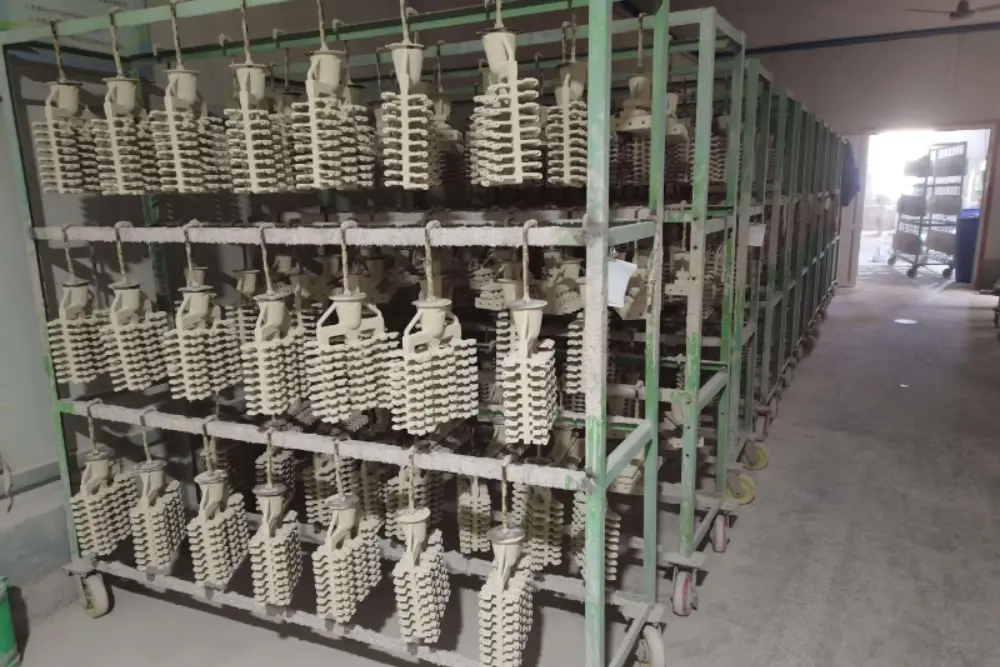
Every aerospace casting begins with a review of the drawing for function, draft and load path, followed by hardened tooling sized for the program. Wax patterns are injected and assembled, then built into a fine silica sol ceramic shell. After dewaxing and pour, the shell is removed, the part is cut from its runner, and functional features are CNC machined to drawing. Final inspection confirms chemistry, dimensions, heat number and, where specified, NDT before certification and packing.
Material Options
Aerospace programs select alloys for strength-to-weight and service temperature:
- 15-5PH / XM-12 — high strength with good toughness for structural hardware.
- 17-4PH — precipitation-hardening strength for fittings and brackets.
- 410 Stainless — hardenable, wear-resistant hardware.
- 304 / CF8 — corrosion-resistant non-structural components.
- Heat-resistant / A286-type alloys — where operating temperature demands it.
Our quoting process states the alloy recommendation explicitly so the component meets both function and specification.
Surface Finishing
Aerospace components need finishes that survive the flight environment. We apply:
- Passivation — reinforces corrosion resistance on stainless parts.
- Shot blasting — cleans and prepares the as-cast surface.
- Cadmium-free coating (option) — a modern, restricted-substance alternative for protection.
- Anodize-ready preparation — where a downstream coating is specified.
Finishes are selected to match the service environment and the assembly’s requirements.
Tolerance Capability
As-cast aerospace features typically hold ISO 8062 CT4 to CT6 tolerances. The features that locate and function — mounting faces, bores, threads and datums — are refined on our CNC centers to ±0.01 mm so the part assembles to the airframe without correction. Repeatable tolerances are what let an assembly line build to plan and trust the fit on the first attempt.
Quality Control
Quality is engineered in, not inspected in. Our aerospace program includes:
- Heat chemistry verification with a direct-reading spectrometer before pour.
- Dimensional inspection on CMMs against the CAD model.
- Non-destructive testing — dye penetrant, magnetic particle or radiographic where the class demands it.
- Traceability — material certificates, dimensional reports, heat numbers and process records travel with the order.
A foundry that cannot prove what it poured, machined and tested is a foundry that cannot be qualified into an aerospace supply chain — so we make the evidence part of the product.
Applications
Aerospace investment castings from Precision Steel Cast are found in:
- Structural brackets and clip angles
- Fittings, couplings and unions
- Housings and frames
- Linkages, levers and bellcranks
- Sensor and actuator bodies
- Engine and auxillary hardware
Each application is reviewed for load, temperature and corrosion exposure so the alloy, tolerance and finish are matched to duty.
Industries Served
- Aerospace — airframe structural and functional parts.
- Defense — durable components for land, sea and air platforms.
- Aircraft Structures — brackets, fittings and frames.
- Engines & Auxillary — hardware for propulsion and systems.
- Space — lightweight, high-strength specialized components.
- Unmanned Systems — mass-critical castings for UAVs.
Because we supply globally, our documentation and packing are aligned with international aerospace procurement and shipping standards.
Design for Manufacturability
The most cost-effective aerospace casting is designed with the process in mind from the first sketch. Our engineers review every inquiry for wall thickness, draft, parting line and the placement of machined features. Where a modest change in geometry can improve shell stability, reduce hot spots or remove a machining operation, we propose it before any tooling is cut. Good design for manufacturability is the difference between a part that machines easily and one that fights you at every step.
Technical FAQ
15-5PH (XM-12) and 17-4PH precipitation-hardening stainless are common for high-strength structural parts; 410 serves hardenable hardware; heat-resistant and A286-type alloys are used where temperature demands it.
Yes. Each heat is spectro-verified and every order can ship with a material certificate, dimensional report, heat number and process records so the grade and history are fully traceable.
Structural brackets, fittings and couplings, housings and frames, linkages, sensor bodies and actuator parts built to drawing.
As-cast features hold ISO 8062 CT4–CT6; machined functional features are finished to ±0.01 mm on CNC centers and verified on CMM against the CAD model.
We verify heat chemistry on a spectrometer, inspect dimensions on CMM, apply NDT where specified, and ship full traceability so the part can be qualified into an aerospace supply chain.
Send drawings, alloy, specification and quantities via the quote form or to hank@precisionsteelcast.com; we return a feasibility review and quotation within 24 hours.
Request a Quote
Precision Steel Cast is ready to support your next aerospace program. Learn more about our related capabilities:
- Investment Casting Manufacturer
- 15-5PH Stainless Steel Casting Manufacturer
- 17-4PH Stainless Steel Casting
- 410 Stainless Steel Casting Manufacturer
- CNC Machining Services for Castings
You can also visit our main site at Precision Steel Cast or email hank@precisionsteelcast.com.