Stainless Steel Valve Casting Manufacturer
Precision Steel Cast is a dedicated stainless steel valve casting manufacturer producing pressure-tight, leak-free components for the world’s most demanding flow-control systems. A valve is only as reliable as its weakest cast feature: a porous body wall, a warped bonnet face or a seat that machines out of true will leak, seize or fail under pressure. We eliminate those failure modes at the source by combining silica sol investment casting with disciplined metallurgy and in-house machining of every sealing surface.
As a valve body investment casting supplier, we work across the full spectrum of valve types — gate, globe, ball, check, butterfly and control — and across the grades that keep them sealing: 316 / CF8M, 304 / CF8, 316L / CF3M, 2205 duplex and 17-4PH for hardened trim. Whether you build a handful of specialty valves or run recurring volume, the casting you receive is dimensionally and metallurgically proven before it leaves our dock.
Introduction
Valves sit at the intersection of pressure, corrosion and motion. Unlike a static fitting, a valve body must contain pressure while its internal parts move, rub and seal repeatedly. That combination punishes any weakness in the casting: a shrinkage cavity becomes a leak path, a coarse grain structure becomes a fatigue origin, and an out-of-flat flange face becomes a bolt-load problem. Investment casting is the natural process for valve components because it produces a single, dense, near-net-shape part with the internal passages and contours that would be impossible or wasteful to machine from bar.
For valve OEMs and distributors, the benefit is consistency. A near-net-shape cast body needs far less stock removal than a sand-cast or fabricated equivalent, which means less scrap of expensive corrosion-resistant alloy and fewer opportunities to introduce machining defects. The result is a body that is both cheaper to produce in volume and more reproducible part to part — exactly what a quality system designed around traceable castings needs.
Manufacturing Capability
Precision Steel Cast runs the full valve casting process under one roof:
| Stage | Capability |
|---|---|
| Tooling | Hardened steel dies and wax tooling built for repeatable valve production. |
| Pattern | Automatic wax injection for consistent, low-variation patterns and assemblies. |
| Shell | Multi-layer silica sol slurry and stucco ceramic shells for clean cavities. |
| Melting | Induction furnaces with precise 316 / duplex / 17-4PH chemistry control. |
| Machining | 3, 4 and 5-axis CNC centers finish flange, seat and bonnet faces. |
| Finish | Electropolishing, passivation and shot blasting applied in-house. |
| Inspect | Spectrometer, CMM and NDT verify chemistry, geometry and integrity. |
Because tooling, pouring and machining happen in one workshop, a CF8M valve casting program never loses accountability in a vendor hand-off. The team that controls the heat is the team that machines the seat and the team that inspects the body, so when a valve leaves our building we can prove exactly what it is made of.
Production Process
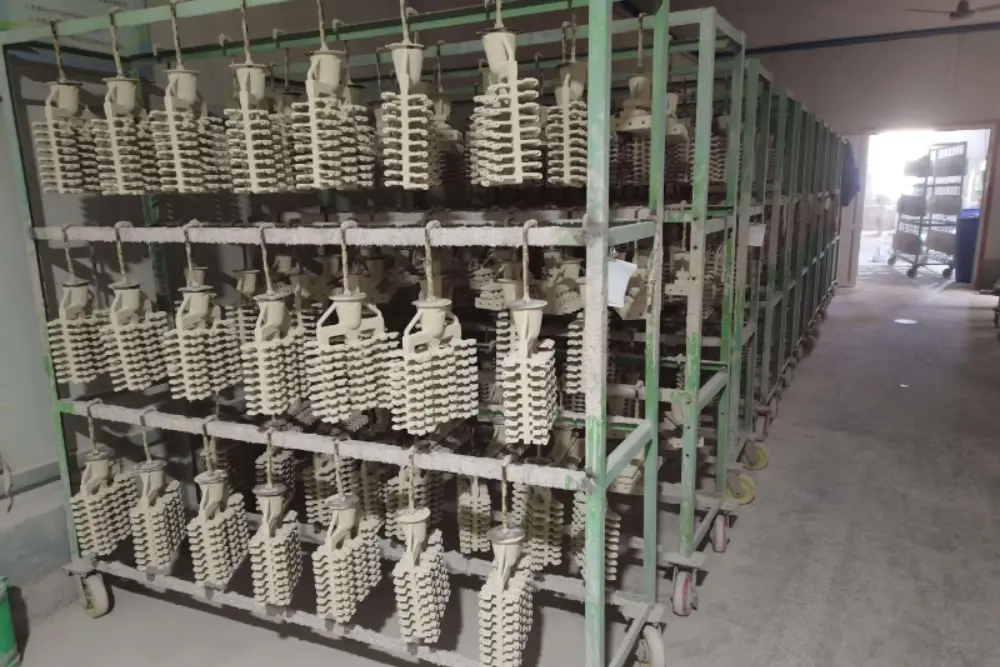
Every valve casting begins with a review of the drawing for wall thickness, draft and parting lines, followed by hardened tooling sized for the run. Wax patterns are injected and assembled, then built into a fine silica sol ceramic shell. After dewaxing and pour, the shell is knocked off, the casting is cut from its runner, and the functional faces are CNC machined to drawing. Final inspection confirms chemistry, dimensions and — where the service demands it — internal soundness, before the part is packed for international shipment.
Material Options
Selecting the right grade is the single biggest decision in a valve program:
- 316 / CF8M — the workhorse austenitic grade for corrosive service, with strong all-round resistance.
- 304 / CF8 — a cost-effective choice for milder, non-aggressive media.
- 316L / CF3M — low-carbon grade for welded valve assemblies and hygienic duty.
- 2205 Duplex — roughly double the strength and far better chloride pitting resistance for seawater and offshore.
- 17-4PH — precipitation-hardening trim and stems where hardness and wear resistance matter.
Our quoting process makes the grade recommendation explicit for each application so the valve performs in service rather than merely meeting a drawing number.
Surface Finishing
Flow and corrosion behavior both depend on surface condition. We apply:
- Electropolishing — smoothes and cleans the bore so flow is laminar and biofouling has less to grip.
- Passivation — reinforces the chromium oxide film for long-term corrosion resistance.
- Shot blasting / pickling — prepares and cleans the as-cast surface.
- Hard chrome or nitride — optional on trim and seats where abrasion or galling is a concern.
For sanitary and high-purity valves, electropolishing is often the default finish because it directly improves cleanability and flow.
Tolerance Capability
As-cast valve features typically hold ISO 8062 CT4 to CT6 tolerances. The features that actually seal — flange faces, seat bores, bonnet registers and threaded ports — are refined on our CNC centers to ±0.01 mm so the casting drops onto standard trim and gaskets without field correction. Tight, repeatable tolerances are what let a valve assembler bolt a body, install trim and trust the seal on the first attempt.
Quality Control
Quality is engineered in, not inspected in. Our valve program includes:
- Heat chemistry verification with a direct-reading spectrometer before pour.
- Dimensional inspection on CMMs against the CAD model.
- Non-destructive testing — dye penetrant, magnetic particle or radiography where the class demands it.
- Traceability — material certificates, dimensional reports and process records travel with the order.
A foundry that cannot prove what it poured, machined and tested is a foundry that cannot be qualified into a pressure-equipment supply chain — so we make the evidence part of the product.
Applications
Stainless steel valve castings from Precision Steel Cast are found in:
- Gate, globe, ball, check and butterfly valve bodies
- Valve bonnets, yokes and actuator housings
- Discs, plugs, seats and trim components
- Control and instrumentation valve bodies
- Cryogenic and high-temperature valve components
- Subsea and topside valve hardware
Each application is reviewed for the media, pressure class and cycle life it will see so the grade, tolerance and finish are matched to duty rather than guessed.
Industries Served
- Oil & Gas — bodies and trim rated for sour and offshore service.
- Water Treatment — corrosion-resistant valves for potable and process water.
- Chemical Processing — castings for aggressive and mixed-media duty.
- Power Generation — turbine and auxillary valve hardware.
- Marine — 316L and duplex valves for continuous seawater exposure.
- Pump & Valve — OEM supply for flow-control manufacturers worldwide.
Because we serve these industries globally, our documentation, certification and packing are aligned with international procurement and shipping requirements.
Design for Manufacturability
The most cost-effective valve casting is designed with the process in mind from the first sketch. Our engineers review every inquiry for wall thickness, draft, parting line and the placement of machined features. Where a modest change in geometry can improve shell stability, reduce hot spots or remove a machining operation, we propose it before any tooling is cut. Good design for manufacturability is the difference between a body that machines easily and one that fights you at every step.
Technical FAQ
316 / CF8M is the most common austenitic choice for general corrosive service. For high chloride or seawater duty, 2205 duplex offers far better pitting resistance, while 304 / CF8 suits milder, cost-sensitive applications.
Yes. Valve bodies and bonnets are cast to pressure-tight standards with dense, porosity-controlled walls. We verify integrity by spectrometer, CMM and, where specified, dye-penetrant or radiographic inspection.
Functional sealing surfaces such as flanges, seats and bonnet faces are CNC machined to ±0.01 mm so the casting seats correctly against standard trim and gaskets without field rework.
Gate, globe, ball, check, butterfly and control valves — including bodies, bonnets, discs, plugs, seats and actuator housings built to customer drawings.
Electropolishing and passivation are standard for corrosion service; hard-chrome or nitride options are available on trim and seats where wear resistance is required.
Send drawings, pressure class, grade, trim requirements and quantities via the quote form or to hank@precisionsteelcast.com; we return a feasibility review and quotation within 24 hours.
Request a Quote
Precision Steel Cast is ready to support your next valve program. Learn more about our related capabilities:
- Stainless Steel Pump Casting Manufacturer
- Stainless Steel Casting Manufacturer
- 316 Stainless Steel Casting
- 304 Stainless Steel Casting
- CNC Machining Services for Castings
You can also visit our main site at Precision Steel Cast or email hank@precisionsteelcast.com.