316L Stainless Steel Casting Manufacturer
Precision Steel Cast is a dedicated 316L stainless steel casting manufacturer producing custom CF3M / 316L components through the silica sol investment casting process. 316L is the low-carbon version of 316: by holding carbon below roughly 0.03%, it avoids sensitization and delivers maximum corrosion resistance — the grade engineers reach for when a part must be welded, stay hygienic or survive the most aggressive media. We help procurement and design teams replace fabricated or machined 316L assemblies with a single near-net-shape casting that is stronger, lighter and cheaper to produce at volume.
As a low carbon stainless casting supplier, we know that the value of 316L lives in its chemistry control. Carbon has to be held low and the melt verified, or the grade loses the very property you specified it for. Shell chemistry, pour practice and passivation are tuned for the grade so every heat delivers the corrosion resistance the application expects.
Introduction
316L stainless steel is the low-carbon member of the 316 family. In cast form it is designated CF3M under the ASTM A351 / A743 family, versus CF8M for standard 316. The difference is carbon: 316 / CF8M typically allows up to about 0.08% carbon, while 316L / CF3M is capped near 0.03%. That small change has a large consequence for welded and hygienic assemblies, because it prevents chromium carbide precipitation at grain boundaries during heating.
For buyers, 316L castings are the right choice wherever a component will be welded into a larger structure, must meet food or pharmaceutical hygiene standards, or faces the most aggressive corrosive duty. A near-net-shape casting reduces raw-material waste and consolidates multi-part fabricated assemblies into one robust, leak-tight piece — and because 316L is more expensive than 304, the scrap and machining savings are proportionally larger.
Material Overview
316L is an austenitic stainless steel: non-magnetic in the annealed condition, tough at low temperatures and easy to form. Like 316 it carries roughly 2–3% molybdenum, which gives it markedly better resistance to chlorides and industrial chemicals than 304. The low-carbon chemistry is what makes it the preferred grade for welded fabrications and sanitary equipment, because it stays corrosion-resistant through the heat of welding without requiring a full post-weld anneal.
We cast both standard 316 / CF8M and low-carbon 316L / CF3M. When a 316L casting will be welded into a larger structure, we recommend CF3M by default and document the chemistry so the weld procedure can be qualified confidently. Where welding is not involved and cost is the priority, 316 / CF8M remains an excellent option.
Manufacturing Capability
Precision Steel Cast runs every step of the 316L casting process under one roof:
| Stage | Capability |
|---|---|
| Tooling | Hardened steel dies and wax-injection tooling built for repeatable 316L production. |
| Pattern | Automatic wax injection for consistent, low-variation patterns. |
| Shell | Multi-layer silica sol slurry and stucco ceramic shells for clean CF3M cavities. |
| Melting | Medium-frequency induction furnaces with precise low-carbon 316L chemistry control. |
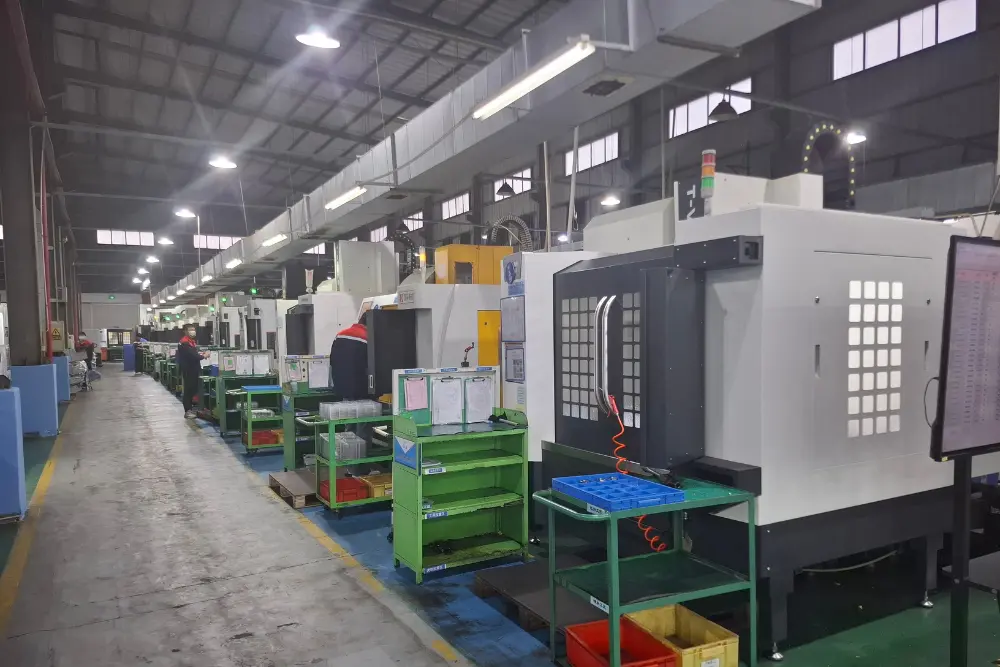
| Machining | 3, 4 and 5-axis CNC centers finish critical sealing and locating features. |
| Finish | Electropolishing, passivation and shot blasting applied in-house. |
| Inspect | Spectrometer, CMM and NDT verify chemistry, geometry and integrity. |
This vertical integration is what lets a 316L stainless steel investment casting supplier guarantee both lead time and quality. The people who pour the heat are the people who machine it and the people who inspect it, so accountability never falls into a vendor gap.
Production Process
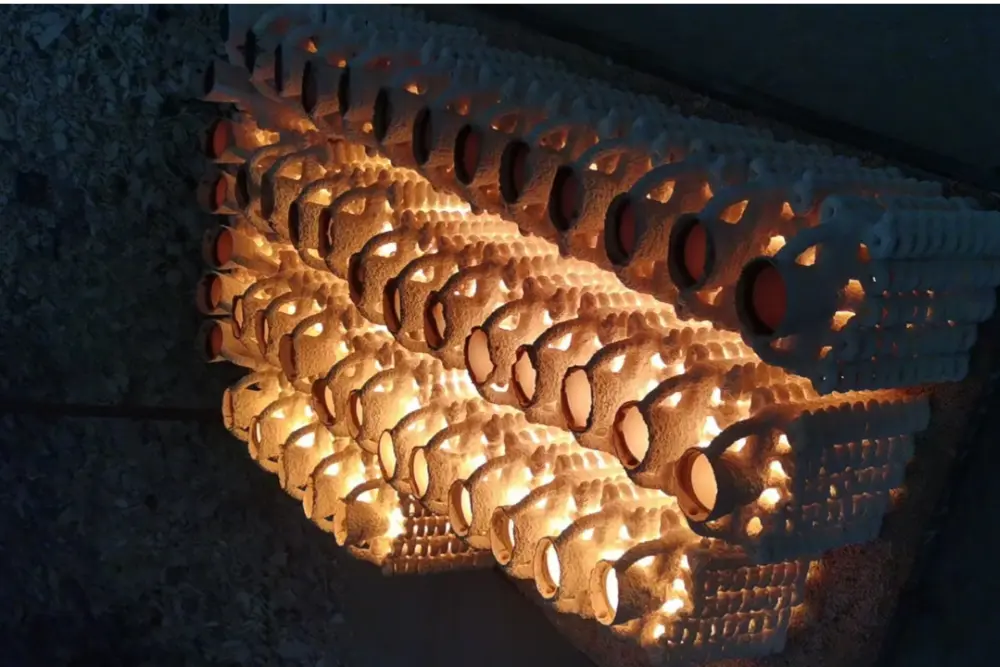
The sequence begins with wax pattern production, followed by building a ceramic shell layer by layer around the assembly. After the shell is cured, the wax is melted out and molten 316L stainless steel is poured into the cavity. Once cooled, the shell is removed, the casting is cut from its runner, CNC machined where required, finished and inspected.
Each step is documented. Wax patterns are checked against master gauges, shell thickness is controlled by the number and composition of slurry layers, and pour temperature is logged for every heat. That documentation is what lets us reproduce a CF3M part identically months or years after the first sample.
Material Characteristics
| Property | 316L / CF3M | Why it matters |
|---|---|---|
| Carbon content | Low (~0.03% max) | Avoids sensitization after welding |
| Corrosion resistance | Superior to 304, especially against chlorides | Reliable in marine, coastal and chemical duty |
| Pitting resistance | High PREN thanks to molybdenum | Resists chloride pitting and crevice corrosion |
| Strength (annealed) | Moderate; ~485–515 MPa tensile | Adequate for most fluid-handling structures |
| Weldability | Excellent; no post-weld anneal usually needed | Easy to join into larger assemblies |
| Hygiene | Smooth, cleanable after electropolishing | Meets food and pharmaceutical expectations |
These characteristics explain why 316L is the default hygienic and welded-grade austenitic casting. Our metallurgy team reviews each specification and confirms whether 316L is appropriate or whether 316 (for milder welded duty) or 2205 duplex (for continuous seawater immersion) would serve better. Grade selection is deliberate, balancing corrosion performance against cost.
Surface Finishing
Finishing is functional, not merely cosmetic. For 316L we offer:
- Electropolishing — removes embedded iron, improves passivation and gives a bright, hygienic finish ideal for food, pharmaceutical and marine duty.
- Passivation — chemically strengthens the chromium oxide layer to maximize corrosion resistance.
- Shot blasting — produces a uniform matte texture and relieves surface stress.
- Pickling — removes scale and weld discolouration after casting or welding.
These treatments are applied in-house, which keeps lead times short and results consistent. For parts destined for hygienic or seawater service, electropolishing also reduces surface roughness so residue and biofouling have less to cling to.
Tolerance Capability
Dimensional accuracy is where investment casting earns its keep. As-cast 316L features typically hold ISO 8062 tolerance grades CT4 to CT6, depending on size and section thickness. Features that must mate with other parts — sealing faces, bores, threads and locating surfaces — are brought to tighter limits through CNC machining, routinely to ±0.01 mm.
We work directly from customer drawings and align inspection and reporting to common international standards, so the numbers on our dimensional report map cleanly to the limits on your specification. Threads are cut or rolled to standard series, bores are held concentric, and flatness of sealing faces is verified so gaskets seat correctly the first time.
Quality Control
Quality is engineered in, not inspected in. Our 316L program includes:
- Heat chemistry verification with a direct-reading spectrometer before pour, confirming low-carbon chemistry.
- Dimensional inspection on coordinate measuring machines against the CAD model.
- Non-destructive testing — dye penetrant, magnetic particle or radiographic inspection where the application demands it.
- Traceability — material certificates, dimensional reports and process records travel with each order.
This disciplined approach is why engineers specify Precision Steel Cast when a casting failure is not acceptable. A foundry that cannot prove what it poured, machined and tested is a foundry you cannot qualify into a hygienic or safety-critical system — so we make the evidence part of the product.
Applications
316L stainless steel castings from Precision Steel Cast are found in:
- Food and dairy process equipment — mixers, fittings, valves and conveyor parts
- Pharmaceutical and bioprocessing components
- Hygienic pipeline and vessel fittings
- Welded marine assemblies — cleats, bollards and deck hardware
- Chemical reactor and pipeline components
- Offshore structure fittings and subsea hardware
Each application is reviewed for the loads, media and temperatures it will see so the grade, tolerance and finish are matched to service. A hygienic mixer shaft is specified differently from a welded seawater bollard, and our quoting process makes that distinction explicit.
Industries Served
- Food Machinery — hygienic, electropolished components that meet sanitary expectations.
- Pharmaceutical — clean, traceable parts for process and packaging equipment.
- Marine — 316L and duplex hardware built to survive continuous saltwater exposure.
- Chemical Processing — corrosion-resistant fittings for aggressive media.
- Offshore — components rated for splash-zone and submerged service.
Because we serve these industries globally, our documentation and packing are aligned with international shipping and procurement requirements. Buyers evaluating a new low carbon stainless casting supplier can begin with a sample batch to validate tooling and finish before committing to volume.
Design for Manufacturability
The most cost-effective 316L casting is designed with the process in mind from the first sketch. Our engineering team reviews every inquiry for wall thickness, draft angles, parting lines and the placement of machined features. Where a modest change in geometry can remove a machining operation, improve shell stability or reduce the risk of hot spots, we propose it before any tooling is cut. Good design for manufacturability is the difference between a casting that machines easily and one that fights you at every step.
Lead Time, Minimum Order and Logistics
Prototype tooling can be produced quickly so design and function are validated before committing to hardened production dies. Once proven, we harden the tooling for volume runs and schedule production to match your assembly line or project milestones. Minimum order quantities are flexible and discussed per project, because a sensible first order should de-risk the relationship for both sides.
Finished castings are packed for international transit, with anti-corrosion measures applied wherever long ocean freight is expected. We coordinate shipments to North America, Europe and Asia so components arrive in step with your build plan rather than sitting in a warehouse.
Why Choose Precision Steel Cast
Buyers choose Precision Steel Cast because a single, vertically integrated partner controls casting, machining and inspection. That integration protects lead time, simplifies traceability and removes the finger-pointing that occurs when casting and machining are split between vendors. Combined with genuine 316L metallurgy knowledge, in-house finishing and responsive engineering, it makes us a dependable 316L stainless steel casting manufacturer for both first articles and recurring production.
Technical FAQ
316L / CF3M is the low-carbon version of 316 / CF8M. Carbon is kept below about 0.03%, which avoids sensitization — the precipitation of chromium carbides at grain boundaries that would otherwise starve the heat-affected zone of corrosion resistance after welding.
Specify 316L whenever the casting will be welded into a larger structure, serves in the most aggressive corrosive media, or must meet hygienic and pharmaceutical standards where maximum corrosion resistance is required.
As-cast features typically hold ISO 8062 CT4 to CT6; machined functional surfaces such as bores, faces and threads are refined to ±0.01 mm on our CNC centers.
Yes. 316L is the standard hygienic grade for food, dairy, beverage and pharmaceutical equipment. Electropolishing gives a smooth, cleanable surface that meets sanitary expectations.
Each order can include a material certificate, dimensional inspection report and process records so the grade, low-carbon chemistry and geometry are fully traceable.
Send drawings, quantity, grade and tolerances via the quote form or to hank@precisionsteelcast.com; we return a feasibility review and quote within 24 hours.
Request a Quote
Precision Steel Cast is ready to support your next 316L stainless steel program. Learn more about our related capabilities:
- 316 Stainless Steel Casting
- 304 Stainless Steel Casting
- Stainless Steel Casting Manufacturer
- CNC Machining Services for Castings
You can also visit our main site at Precision Steel Cast or email hank@precisionsteelcast.com.