410 Stainless Steel Casting Manufacturer
Precision Steel Cast is a 410 stainless steel casting manufacturer producing 1.4006 martensitic components where hardness, strength and wear resistance matter more than maximum corrosion resistance — valve trim, pump wear parts, fasteners, gears and machinery hardware. 410 is the workhorse hardenable stainless: heat-treat it and it gains the toughness to resist abrasion and galling, while still carrying the stainless name for moderate corrosive service. That makes it the cost-effective bridge between carbon steel and the austenitic 304/316 grades.
As a martensitic stainless casting supplier, we know the heat treatment defines the part. A 410 casting is soft and machinable as cast, then quenched and tempered to the target hardness. Our controlled melting, in-house heat treatment and spectrometric verification are what turn a casting into a qualified, hardenable component.
Introduction
Martensitic stainless grades solve a specific problem: how to get hardness and wear resistance while keeping some stainless corrosion behavior and good machinability before treatment. 410 does this by quenching into a martensitic structure and then tempering to the target hardness. The result is a casting that can be machined in a soft condition and then hardened — convenient, repeatable and documentable.
For component engineers, 410 is the economical high-strength choice. Its hardenability lets valve seats, pump sleeves and fasteners resist wear and deformation, and its castability lets complex trim be made as a single near-net-shape part instead of a fabricated assembly. Investment casting is ideal because it reproduces the integrated features — seats, profiles, cored passages — that make a 410 part both functional and economical.
Manufacturing Capability
Precision Steel Cast runs the full 410 casting process under one roof:
| Stage | Capability |
|---|---|
| Tooling | Hardened steel dies and wax tooling built for repeatable 410 production. |
| Pattern | Automatic wax injection for consistent, low-variation patterns. |
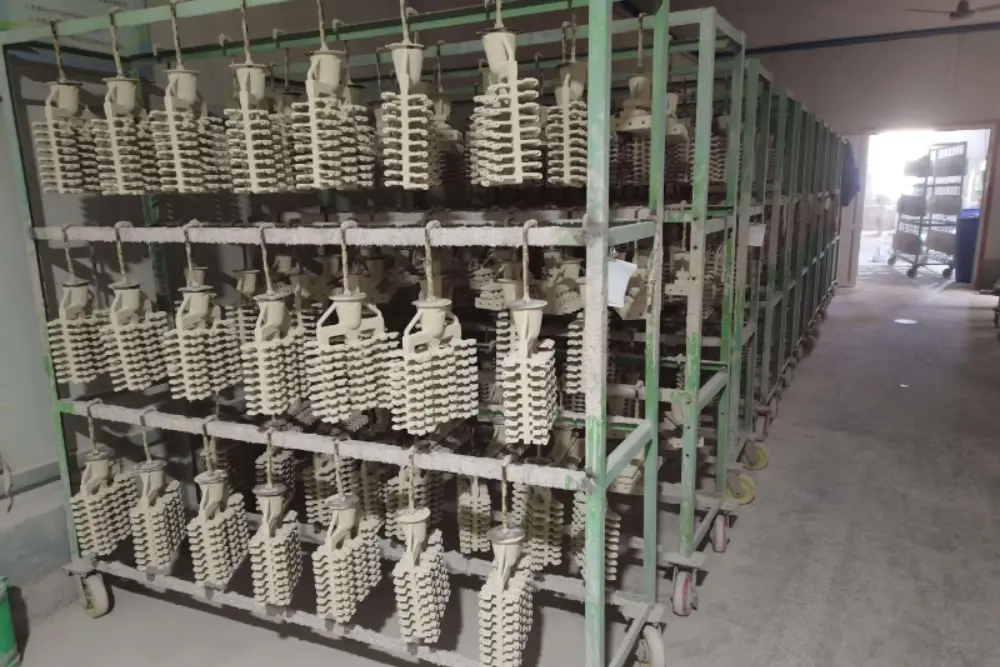
| Shell | Multi-layer silica sol ceramic shells for clean, dense cavities. |
| Melting | Induction furnaces with precise 410 / 1.4006 chemistry control. |
| Heat Treat | Quench and temper to the specified hardness. |
| Machining | Rigid CNC centers finish locating and functional features. |
| Inspect | Spectrometer, CMM and NDT verify chemistry, geometry and integrity. |
Because tooling, pouring, heat treatment and machining share one workshop, a 410 program never loses accountability in a vendor hand-off. The team that controls the heat is the team that hardens and machines the part, so when a component leaves our building we can prove exactly what it is made of.
Production Process
Every 410 casting begins with a review of the drawing and the specified hardness, followed by hardened tooling sized for the run. Wax patterns are injected and assembled, then built into a fine silica sol ceramic shell. After dewaxing and pour, the casting is quenched and tempered to the target hardness. Functional features are then CNC machined to drawing. Final inspection confirms chemistry, hardness, dimensions and, where specified, NDT before certification and packing.
Material Options
We cast the martensitic family to match duty:
- 410 / 1.4006 (cast) — hardenable, wear-resistant general stainless.
- 410 hardened & tempered — to a customer-specified hardness band.
- 420 Stainless — a higher-carbon option for greater hardness/wear.
- CA15 / CA40 — cast martensitic grades for corrosion-and-wear service.
Our quoting process states the grade and hardness recommendation explicitly so the component meets both wear and corrosion targets.
Surface Finishing
410 components often need wear-resistant finishes. We apply:
- Passivation — reinforces the chromium oxide film for corrosion resistance.
- Shot blasting — cleans and prepares the as-cast surface.
- Hard chrome (option) — for abrasion resistance on trim and seats.
- Nitride (option) — for galling and wear resistance on mating surfaces.
Finishes are selected to match the service environment and the assembly’s requirements.
Tolerance Capability
As-cast 410 features typically hold ISO 8062 CT4 to CT6 tolerances. The features that locate and function — faces, bores, threads and datums — are refined on our CNC centers to ±0.01 mm so the part assembles without correction. Because the grade is machined before hardening, we control distortion through the heat-treat cycle so finished features stay accurate.
Quality Control
Quality is engineered in, not inspected in. Our 410 program includes:
- Heat chemistry verification with a direct-reading spectrometer before pour.
- Heat-treatment records documenting quench and temper.
- Dimensional inspection on CMMs against the CAD model.
- Traceability — material certificates, dimensional reports, heat numbers and process records travel with the order.
A foundry that cannot prove the hardness of a 410 heat is a foundry that cannot be qualified into a wear-service supply chain — so we make the evidence part of the product.
Applications
410 stainless castings from Precision Steel Cast are found in:
- Valve trim, seats and discs
- Pump wear rings, sleeves and impellers
- Fasteners, pins and dowels
- Gears, sprockets and ratchets
- Shafts, bushings and collars
- General machinery hardware
Each application is reviewed for load, wear and corrosion exposure so the hardness, tolerance and finish are matched to duty.
Industries Served
- Valve & Pump — trim and wear components for flow control.
- Oil & Gas — hardenable, moderately corrosion-resistant hardware.
- General Engineering — machinery and structural castings.
- Automotive — hardenable brackets and linkages.
- Power Generation — turbine and auxillary hardware.
- Mining — abrasion-resistant components.
Because we supply globally, our documentation and packing are aligned with international procurement and shipping standards.
Design for Manufacturability
The most cost-effective 410 casting is designed with the process in mind from the first sketch. Our engineers review every inquiry for wall thickness, draft, parting line and the placement of machined features. Where a modest change in geometry can improve shell stability, reduce hot spots or remove a machining operation, we propose it before any tooling is cut. Good design for manufacturability is the difference between a part that machines easily and one that fights you at every step.
Technical FAQ
410 is a martensitic stainless steel that can be hardened by heat treatment. After quenching and tempering it offers good strength and wear resistance with moderate corrosion resistance — a cost-effective step up from carbon steel where some stainless behavior is needed.
Choose 410 when hardness, strength and wear resistance matter more than maximum corrosion resistance — trim, seats, fasteners and machinery parts. For aggressive corrosive service, 304 or 316 are the better choice.
Yes. We heat treat 410 to the specified hardness and temper, then supply heat-treatment records and material certificates so the properties are traceable.
Valve trim and seats, pump wear parts, fasteners and pins, gears and sprockets, shafts and sleeves, and general machinery hardware built to drawing.
Hard chrome or nitride options are available on wear surfaces such as trim and seats where additional abrasion or galling resistance is required.
Send drawings, hardness requirement, specification and quantities via the quote form or to hank@precisionsteelcast.com; we return a feasibility review and quotation within 24 hours.
Request a Quote
Precision Steel Cast is ready to support your next 410 program. Learn more about our related capabilities:
- Stainless Steel Valve Casting Manufacturer
- Stainless Steel Pump Casting Manufacturer
- 17-4PH Stainless Steel Casting
- Stainless Steel Casting Manufacturer
- CNC Machining Services for Castings
You can also visit our main site at Precision Steel Cast or email hank@precisionsteelcast.com.