Investment Casting Process
Investment casting — often called lost-wax casting — is the process behind the dense, precise stainless components that fill modern industry. From a surgical instrument body to a pump impeller to an aircraft bracket, investment casting turns a CAD model into a near-net-shape metal part with detail that would be slow, wasteful or impossible to machine. This guide walks through how the process actually works, step by step, and why engineers specify it.
Unlike sand casting, which leaves a coarse, porous surface, investment casting uses a fine ceramic shell built around a wax pattern. The result is a smooth cavity that reproduces fine features and tight contours. For stainless steel in particular, the cleanliness of that shell matters: any contamination in the mold wall can end up in the casting. That is why we use a silica sol binder rather than the coarser water-glass process for demanding components.
What Is Investment Casting?
At its core, investment casting is a three-part choreography: make a precise wax replica of the part, surround it with a ceramic shell, then replace the wax with molten metal. The word “investment” is historical — the wax pattern is “invested” (surrounded) by the ceramic slurry. Because the metal freezes in a cavity that exactly mirrors the wax, the finished part carries the detail of the pattern without the parting-line and draft constraints of die casting or the roughness of sand casting.
The biggest practical advantage is near-net-shape. A casting arrives close to final dimensions, needing only the sealing and locating features machined. That minimizes scrap of expensive stainless and shortens lead time — a decisive factor when the alloy costs more per kilogram than the labor to shape it.
The Step-by-Step Investment Casting Process
1. Tooling and Wax Pattern
Every program starts with tooling. For prototypes we can use rapid patterns; for production we cut hardened steel dies that inject wax into the exact cavity shape. Wax is injected, cooled and ejected, then individual patterns are assembled onto a wax runner tree so many parts share one pour. Consistent wax injection is what keeps the whole process repeatable.
2. Ceramic Shell Building
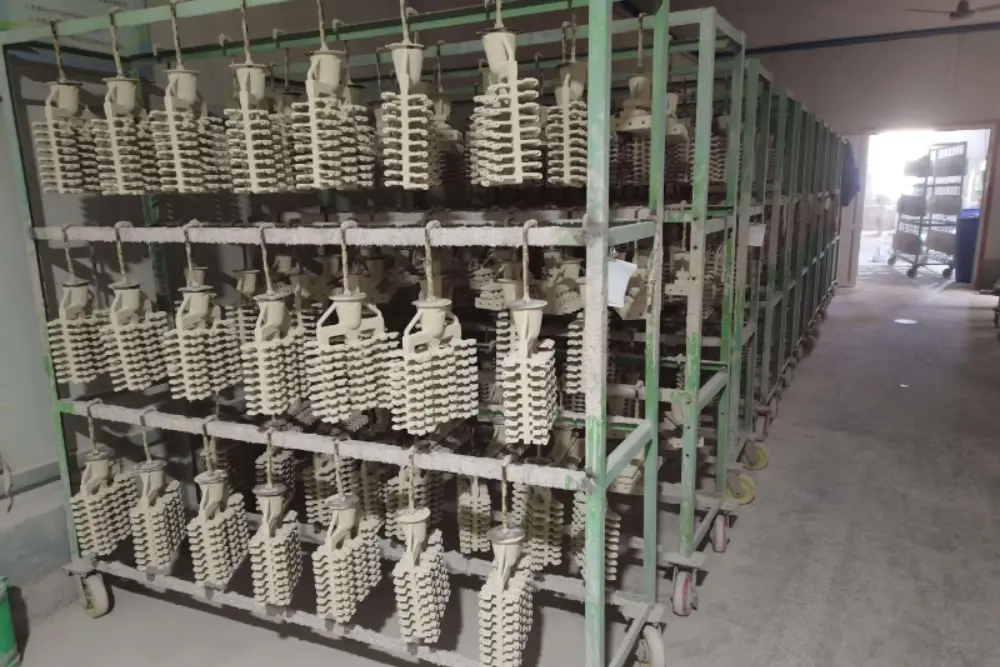
The wax tree is dipped into a silica sol slurry and coated with stucco (sand) repeatedly — typically eight to twelve layers. Each layer dries before the next is applied, building a shell perhaps several millimetres thick. The silica sol binder gives a fine, dense inner face that defines surface finish and accuracy. This is the stage where process discipline separates a good foundry from a poor one.
3. Dewaxing
Once the shell is strong enough, the wax is removed. In steam or flash dewaxing, the wax melts and drains out, leaving a hollow ceramic shell that is the negative of the part tree. The empty shell is then fired to burn out any residual wax and strengthen it for the pour.
4. Pouring
The shell is filled with molten stainless steel from an induction furnace. We verify the heat chemistry on a spectrometer before pour, then pour at a controlled temperature into the pre-heated shell. Because the cavity is already dimensionally stable, the metal freezes into the precise shape the wax defined.
5. Shell Removal and Cut-off
After cooling, the ceramic shell is knocked, vibrated or chemically leached away, and the individual castings are cut from the runner tree. What remains is the raw near-net-shape part, ready for finishing.
6. Machining and Inspection
Functional surfaces — flanges, bores, seats, threads, datums — are CNC machined to drawing, typically to ±0.01 mm. Final inspection confirms chemistry, dimensions on CMM and, where specified, internal soundness by NDT. Material certificates and process records travel with the order.
Materials We Cast
Investment casting is remarkably material-flexible. At Precision Steel Cast we routinely cast:
- Austenitic stainless — 304 / CF8, 316 / CF8M, 316L / CF3M
- Duplex stainless — 2205, 2507 super duplex
- Precipitation-hardening — 17-4PH, 15-5PH / XM-12
- Martensitic stainless — 410, 420
- Carbon and alloy steels — where cost drives the design
The process suits almost any alloy that can be melted and poured, which is why it spans industries from medical to aerospace.
Design Considerations
Good investment castings start with design for manufacturability. Key rules:
| Consideration | Guideline |
|---|---|
| Wall thickness | Keep uniform; avoid massive sections next to thin ones |
| Draft | Minimal draft needed vs. die casting |
| Parting line | None — a major advantage over other processes |
| Undercuts | Possible via soluble cores, but add cost |
| Machined features | Place only where function demands |
Because there is no parting line, investment casting can produce geometry that sand or die casting cannot. The trade-off is tooling lead time and the cost of shell building — which is why it suits complex, value-dense parts rather than simple high-volume shapes.
Quality and Inspection
Quality in investment casting is built, not inspected. Our program verifies:
- Heat chemistry on a spectrometer before pour.
- Dimensional accuracy on CMMs against the CAD model.
- Internal soundness via dye penetrant, magnetic particle or radiography where specified.
- Traceability — certificates, reports and process records with every order.
This evidence is what lets a casting be qualified into medical, automotive, aerospace or pressure-equipment supply chains.
Benefits Over Other Processes
Investment casting is not always the right answer, but it wins clearly when:
- The part is complex with contours, bosses or cored passages.
- The alloy is expensive, so near-net-shape minimizes scrap.
- Tolerances and surface finish matter more than absolute unit cost.
- Low-to-medium volume does not justify die-casting tooling.
Where a simple shape needs millions of units, die casting may win on cost. But for the components that define product performance, investment casting is usually the better process.
Technical FAQ
Investment casting, also called lost-wax casting, is a process where a wax pattern is coated in ceramic to form a shell, the wax is melted out, and molten metal is poured into the cavity to make a precise, near-net-shape component.
The core steps are: tooling and wax pattern making, ceramic shell building, dewaxing, pouring, shell removal and cut-off, heat treatment, CNC machining of functional features, and final inspection.
Silica sol binder produces a finer, denser ceramic shell than water glass, giving better surface finish and dimensional accuracy — ideal for stainless steel components where cleanliness and tolerance matter.
As-cast features typically hold ISO 8062 CT4 to CT6; functional surfaces finished on CNC centers reach ±0.01 mm.
Stainless steels (304, 316, 316L, duplex, 17-4PH, 15-5PH, 410), carbon and alloy steels, and many specialty alloys are routinely investment cast.
Choose investment casting when a part is complex, low-volume-to-medium-volume, or made from an expensive alloy where machining from solid would waste material and cost. It is strongest for near-net-shape, high-complexity components.
Request a Quote
Precision Steel Cast is ready to turn your design into a precise investment casting. Learn more about our process capabilities:
- Investment Casting Manufacturer
- Lost Wax Casting Manufacturer
- Silica Sol Investment Casting Manufacturer
- Stainless Steel Casting Manufacturer
- CNC Machining Services for Castings
You can also visit our main site at Precision Steel Cast or email [email protected].