Stainless Steel Casting Tolerance Guide
Tolerances decide whether a casting assembles on the first try or fights you on the line. This stainless steel casting tolerance guide explains what investment casting can actually hold, how as-cast limits compare to machined features, and how to specify tolerances on your drawing so you get a part that performs without paying for precision you do not need.
The short version: stainless steel investment castings hold ISO 8062 CT4 to CT6 as-cast, and the features that actually function — bores, faces, threads and datums — are finished on CNC centers to ±0.01 mm. Knowing which features belong in which bucket is the difference between a cost-effective casting and an over-specified, over-priced one.
Understanding Casting Tolerances
Casting tolerance is expressed in the ISO 8062 standard as a “CT” grade. The grade sets the permissible deviation from a nominal dimension, and that deviation grows with the size of the feature. In other words, a 10 mm feature and a 200 mm feature at the same CT grade have different absolute limits — larger dimensions are allowed a larger spread.
| Grade | Relative precision | Typical use |
|---|---|---|
| CT4 | Very tight | Critical, high-value stainless components |
| CT5 | Tight | Precision investment castings |
| CT6 | Good | General precision castings |
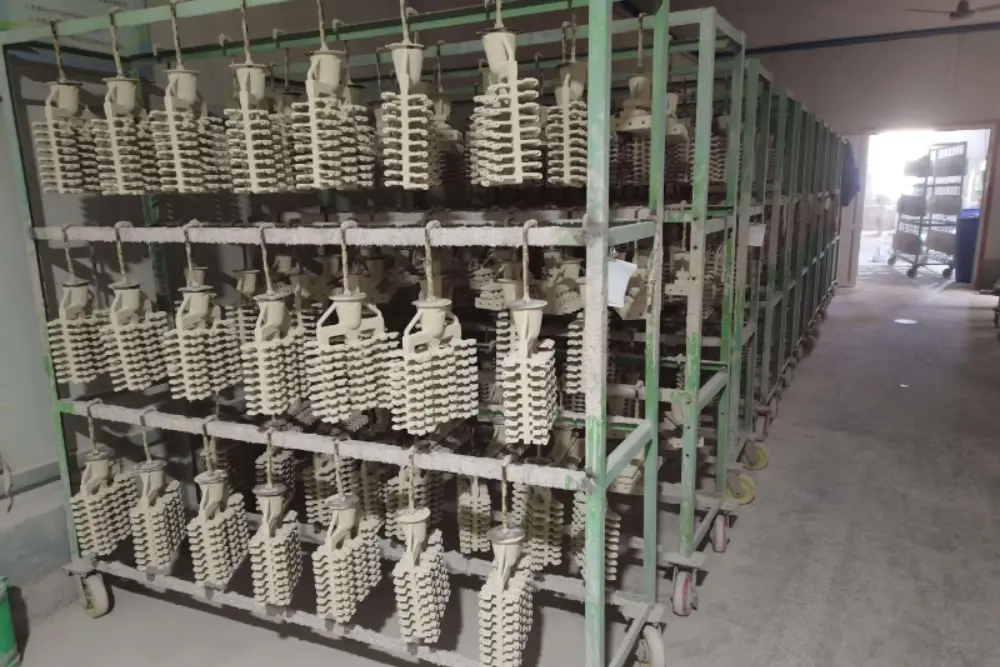
Investment casting reaches these grades because the ceramic shell is dimensionally stable and the wax pattern is highly accurate. Sand casting, by contrast, rarely better than CT8–CT10, which is why investment casting is chosen when geometry and fit matter.
Casting vs Machined Tolerances
It is important to separate what the casting process delivers from what machining delivers:
The rule of thumb: leave form and non-critical geometry as-cast, and machine only the features that seal, locate or bear load. This balances cost against function.
How to Specify Tolerances on a Drawing
A tolerance callout is only useful if it is unambiguous. Good casting drawings:
- State the ISO 8062 CT grade for as-cast features (e.g. “CT5 overall”).
- Call out machined tolerances (e.g. ±0.01 mm) only on functional surfaces.
- Define clear datums so inspection measures from a consistent reference.
- Avoid blanket tight tolerances on every dimension — they inflate cost without benefit.
When a drawing specifies ±0.05 mm everywhere “just to be safe,” it forces machining on features that could have been left as-cast, adding operations and scrap. A targeted callout is cheaper and more reliable.
Factors That Affect Tolerance
Several process variables influence the final tolerance:
- Pattern and wax accuracy — the starting replica sets the ceiling.
- Shell stability — a stable ceramic shell holds dimension through the pour.
- Pour and solidification control — consistent cooling reduces distortion.
- Part geometry — uniform walls distort less than mixed thick/thin sections.
- Section uniformity — hot spots cause local shrinkage and variation.
Our process controls each of these: accurate wax injection, multi-layer silica sol shells, spectrometric heat verification and controlled solidification. That control is what lets us hold CT4–CT6 consistently rather than occasionally.
Section-by-Section Tolerance Expectations
Different feature types have different realistic limits:
- Overall length / width — CT4–CT6 depending on size.
- Wall thickness — controlled by pattern; specify a practical minimum.
- Hole diameter — as-cast is limited; small precise holes are better drilled.
- Flatness of faces — as-cast is fair; CNC improves sealing faces.
- Positional features — datums and machining give the tightest control.
Designing with these expectations in mind avoids requesting the impossible and keeps the quote realistic.
Achieving Tight Tolerances
When a feature needs more than the as-cast process comfortably gives, we do not fight the casting — we machine it. A near-net-shape casting is deliberately left with stock on functional surfaces, which are then finished on 3, 4 and 5-axis CNC centers to ±0.01 mm and verified on CMM. This hybrid approach delivers both the complex geometry of casting and the precision of machining, at a far lower cost than machining the whole part from solid stock.
Technical FAQ
As-cast features typically hold ISO 8062 CT4 to CT6. After CNC machining of functional surfaces, features such as bores, faces and threads reach ±0.01 mm.
CT stands for Casting Tolerance grade in ISO 8062. A lower number is tighter: CT4 is the most precise, CT6 is looser but still excellent for casting. The allowed deviation grows with the nominal dimension.
No. Only machine the features that actually function — sealing faces, bores, datums and threads. Leaving non-critical surfaces as-cast saves cost and lead time without hurting performance.
State the ISO 8062 CT grade for as-cast features, call out machined tolerances (e.g. ±0.01 mm) only on functional surfaces, and define clear datums so inspection is unambiguous.
Pattern/wax accuracy, shell stability, pour and solidification control, part geometry, and section uniformity all influence the final tolerance.
Below CT4, additional cost rises sharply and consistency drops. For features needing more than CT4, we machine them on CNC centers to ±0.01 mm rather than relying on the as-cast process.
Request a Quote
Precision Steel Cast is ready to help you specify and produce castings to the tolerance your application needs. Learn more about our capabilities:
- Investment Casting Process
- Stainless Steel Casting Manufacturer
- Precision Casting Manufacturer
- CNC Machining Services for Castings
- Investment Casting Manufacturer
You can also visit our main site at Precision Steel Cast or email [email protected].