CNC Machining Services for Stainless Steel Castings
Precision Steel Cast provides CNC machining services for stainless steel castings that turn a rough casting into a finished, print-ready component. Casting gets you the shape; machining delivers the seats, bores, threads and datums that make the part assemble and seal. Because our CNC cells sit next to the foundry, a casting moves from shell removal to finishing cut without a freight forwarder in between.
As a precision CNC machining partner, we handle both the castings we pour and customer-supplied stainless parts, finishing them to tolerance with documented inspection.
Introduction
Stainless steel is unforgiving to machine: it work-hardens, conducts heat poorly and tends to gum up cutting edges. That is exactly why machining should be done by people who also cast the material — they understand its behavior from melt to cut. Our machining teams select tooling geometry, coolant strategy and parameters for each grade, whether that is free-machining 304 or stubborn 17-4PH and duplex.
Work-hardening is the central challenge: once the cutting edge rubs instead of shearing, the surface consolidates and wears the tool. We hold a constant chip load, use sharp positive-rake inserts and keep coolant delivered exactly at the cut so heat leaves with the chip rather than soaking into the part. The payoff is a clean, dimensionally stable surface that does not drift as the run progresses.
For buyers, integrated machining means one accountable source for the finished part. You do not chase a foundry for the casting and a shop for the machining and then arbitrate when the bore is out. The same quality system that poured the metal also measures the cut.
Manufacturing Capability
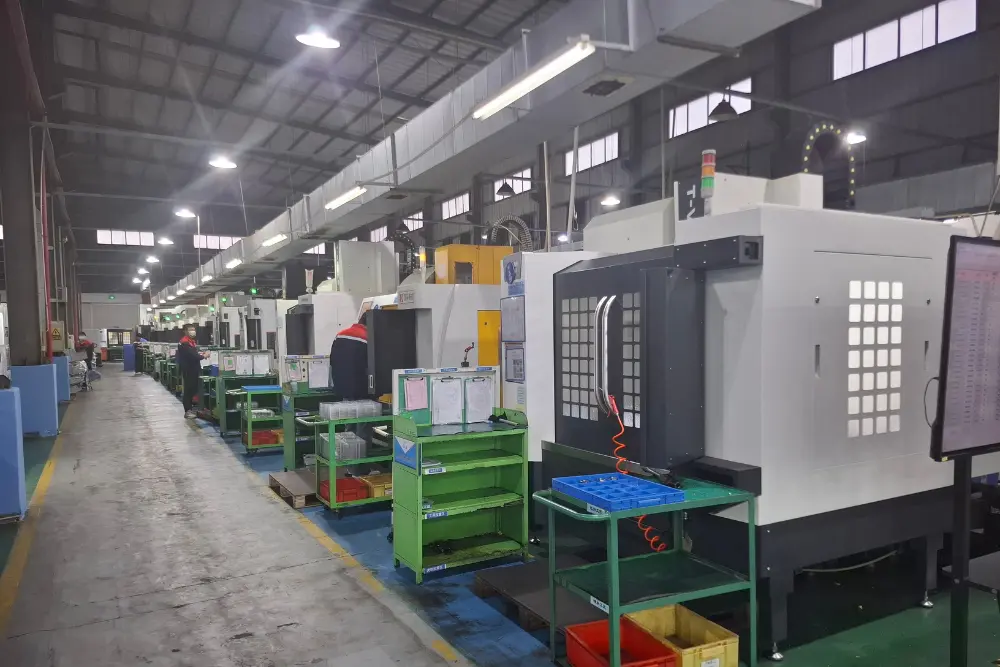
Our machining cell is built around flexible, multi-axis equipment:
| Capability | Equipment | Typical work |
|---|---|---|
| Turning | CNC lathes | Bores, threads, diameters, faces |
| Milling | 3 and 4-axis VMCs | Pockets, flats, contours, features |
| 5-axis | Simultaneous 5-axis | Complex angles, impellers, curved surfaces |
| Drilling / Boring | Drill & bore centers | Holes, reamed bores, intersecting passages |
| Threading | Single- and multi-point | Internal/external standard and custom threads |
This range lets us finish a casting in as few setups as possible, which protects both tolerance and throughput. Fewer setups mean fewer datum transfers and less accumulated error.
For cast stainless we often design fixtures around the as-cast shape, locating from features that will not be cut so the finished datums stay true to the original part. Where a feature is difficult to reach, we use 5-axis positioning to attack it in a single clamping rather than re-fixturing and re-indicating the component.
Production Process
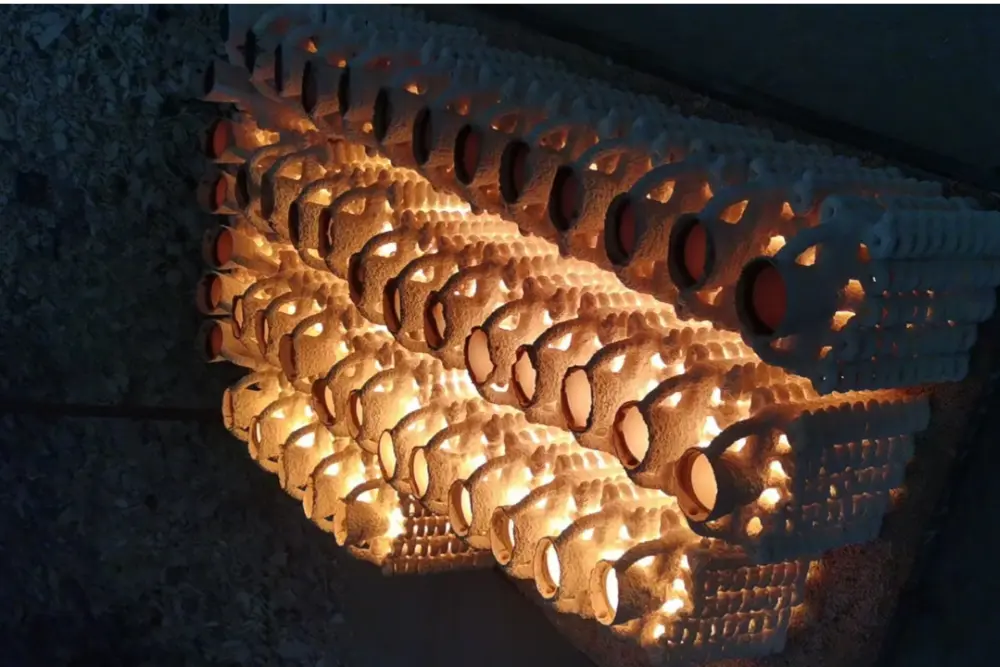
Machining starts by stabilizing the casting in a fixture that references the as-cast datums, then roughing removes stock before finishing cuts lock in tolerance. For castings we produce, we design the gate and parting line with machining in mind, leaving uniform stock on faces that will be cut. The result is predictable, repeatable, and lean.
Material Options
| Grade | Machining note | Typical machined parts |
|---|---|---|
| 304 | General-purpose, work-hardens | Fittings, brackets, housings |
| 316 | Chloride service, tougher cut | Valve bodies, marine hardware |
| 17-4PH | Hardenable, needs sharp tooling | Structural, wear parts |
| 2205 | Duplex, high strength | Chemical, seawater parts |
| 2507 | Super duplex, aggressive duty | Offshore, high-pressure parts |
We choose speeds, feeds and tool coatings per grade so surface finish and tool life stay controlled. Machining the right alloy correctly is as much metallurgy as mechanics.
Surface Finishing
Machined stainless parts are finished to match their duty:
- Electropolishing — smooths and passivates for hygienic and corrosive service.
- Passivation — reinforces the chromium oxide film after cutting exposes fresh metal.
- Shot blasting — uniform matte texture and stress relief.
- Pickling — clears heat tint and scale.
In-house finishing keeps the part moving and lets us deliver a component that is cut, finished and inspected under one roof.
For food and pharmaceutical duty, an electropolished surface also simplifies cleaning validation, since a smooth, non-porous finish gives bacteria nowhere to adhere — a detail that matters once a part leaves the machine and enters a hygienic line.
Tolerance Capability
Functional and mating surfaces are routinely machined to ±0.01 mm, with geometry controlled by CMM. We work directly from your drawing and report to common international standards, so inspection numbers map to your limits.
Threads are cut or rolled to standard series, bores are held concentric to their sealing faces, and flatness of seats is verified so gaskets seal first time. Where a feature sits in a pressure boundary, we apply the density and leak controls the rating demands rather than treating every surface identically.
Our machinists read GD&T callouts directly from your model, so a position tolerance, a profile tolerance or a flatness callout is honored as specified rather than approximated. When a drawing is ambiguous, we ask before cutting — clarifying a datum now is cheaper than scrapping a finished part later, and it protects the repeatability of every part that follows in the run.
Quality Control
Machining quality is verified, not assumed:
- In-process checks — first-article and periodic measurement during the run.
- CMM inspection — final dimensional verification against the 3D model.
- Surface and NDT — roughness, dye penetrant or other tests where specified.
- Traceability — dimensional reports and process records travel with the order.
This is the evidence a qualified buyer needs to bring a new CNC machining source into a controlled supply chain.
Applications
Machined stainless castings from Precision Steel Cast support:
- Pump impellers and volutes with balanced bores
- Valve bodies, bonnets and trimmed seats
- Marine hardware with threaded and faced features
- Food machinery parts with hygienic, polished surfaces
- Chemical fittings and flanges
- Automotive brackets and sensor housings
Each part is reviewed for the features that matter — a sealing face is not machined like a decorative bracket — and our quoting reflects that priority.
We also advise on stock allowance so machining removes just enough to clean up a face without over-cutting into porosity-prone regions near the casting skin. That balance between yield, cost and integrity is where casting-aware machining earns its keep.
Industries Served
- Pump & Valve — bores, seats and threads held to sealing-critical limits.
- Marine — 316 and duplex parts finished for continuous seawater exposure.
- Automotive — stable-tolerance parts for volume assembly.
- Food Machinery — electropolished, hygienic machined surfaces.
- Chemical Processing — corrosion-resistant, inspected fittings.
We serve these industries worldwide, so packing and documentation follow international shipping and procurement norms. New buyers can start with a sample batch to prove capability before volume commitment.
Design for Manufacturability
The easiest casting to machine is designed with machining in mind. We review drawings for stock allowance, datum strategy, feature access and thread placement, and propose changes that reduce setups or avoid thin, chatter-prone sections before cutting begins. A modest change in a boss or rib can remove a second operation on every part for the life of the program.
That early dialogue protects both cost and tolerance, which is why we ask for models early rather than after the casting is poured.
Lead Time and Logistics
Because machining sits beside the foundry, lead time is short and scheduling is fluid: we can pour, machine and finish in one flow rather than handing off between vendors. Minimum order quantities are flexible and set per project, so a sensible first order de-risks both sides.
Finished parts are packed for international transit with anti-corrosion measures where ocean freight demands it. We ship to North America, Europe and Asia so components arrive in step with your build plan.
Why Choose Precision Steel Cast
Buyers choose Precision Steel Cast because casting and machining share one quality system, one building and one accountable team. That integration removes the gaps where tolerance and traceability are lost between vendors, and it lets a stainless part move from melt to finished cut without leaving our control. With broad grade coverage, multi-axis capability and in-house inspection, we are a dependable source for CNC machining services for stainless steel castings from prototype to production.
Because the same team pours the metal and cuts the steel, a tolerance problem is solved at the root rather than argued over after the fact. If a bore repeatedly drifts, the foundry adjusts the gate and the machinist adjusts the fixture in the same building — which is the practical difference between a vendor and a partner.
Technical FAQ
We machine both castings we produce in-house and customer-supplied stainless castings or bar stock, finishing them to drawing with full inspection.
We operate 3, 4 and 5-axis machining centers plus turning, covering milling, drilling, boring, threading and contouring of stainless cast parts.
Functional and mating surfaces are routinely machined to ±0.01 mm; we work to your drawing and report to international standards.
Yes. We machine 304, 316, 17-4PH, 2205 and 2507 duplex, selecting tooling and parameters for each alloy's work-hardening behavior.
Yes. CMM dimensional inspection, surface checks and NDT where required are performed in-house, with reports supplied per order.
Send drawings, alloy, quantities and tolerances via the quote form or to hank@precisionsteelcast.com; we return a quote within 24 hours.
Request a Quote
Precision Steel Cast is ready to finish your next stainless steel casting program. Explore our related capabilities:
Visit our main site at Precision Steel Cast or email hank@precisionsteelcast.com.